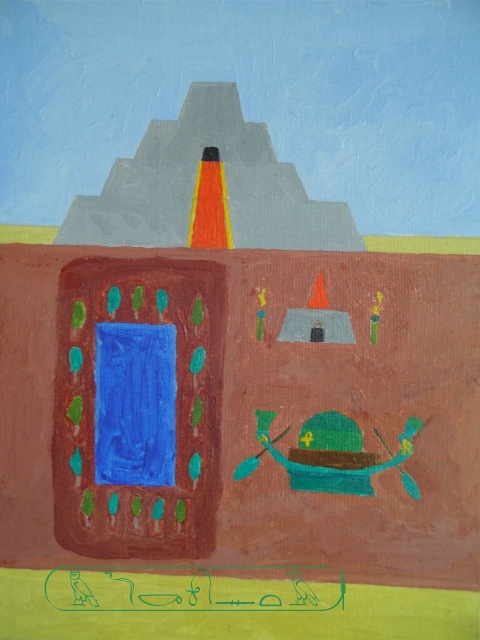
Mortuary Temple of Hor
...
Mortuary Temple:
© Copyright 2009 MC7, All rights reserved.
© Copyright 2009 MC7, All rights reserved.
Introductory Hymn to Hor, God of the Sky:
“Hail Hor, Guardian of the West, Keeper of the Flame of Eternity! O you who has seen the Earth with your Golden Eye, I am comforted by your sacred light. Illuminate me with the Light of Order, as I enter your realm at Dusk. I adore you, Golden Falcon, giver of peace and establisher of civilization upon Geb; O he who is vindicated before your father, Asares, the ruler of Duat. I worship you in my modest Temple, my House of Life, in the form of Chief Lector Priest of the Temple of Hor, and Divine Scribe. Protect my family with your invigorating light, O Hor, as I protect the sacred Boat of the Sky. May my family be prosperous and healthy in my absence.
“I adore you, Golden One of the East; the Mansion of your father is in festival, and your people cheer in waiting for your divine presence. Let the Noble Winds be stilled. Hail to you, King of Kings, Prince of Light, Lord of Order, Vindicator of the Blessed at Judgment. I am vindicated with Ma’at, I am given Ma’at by Toth himself. I am the invisible and unseen one who directs the righteous to the West, who is given cakes and ale upon the altar, and silk vestments in the Chapel in the House of Light.
“Hail to you, O Crimson Orb of Morning Light, who gives justice to the living that they may cease their fighting and calm their rages. O Hor, who was born as Harpocrates the Child, nursed by Hathor, nurtured by Isis, and strengthened by Nut, I adore you. O Hor, who was once blinded in the fight against Darkness, and yet prevailed, I cherish your presence. O Hor, who was healed by Seshet, trained by Neith, and conditioned by Anubis, I have come to prepare the way for your sacred Boat. May your days be spent in happiness with your friends and family among the Neteru.
“Hail to you, O Protector of the Righteous, who battles against evil so as to bar them from influencing the Living; protect your adorers likewise. I adore you O Hor, that I may be protected as I board the sacred boat to your Domain in the Skies. May my kinsmen, who also adore you, be protected from all that would wish them harm or corruption of law.
“O Hor of the Horizon, the Sphinx of Giza, Guardian of Secrets, Protector of the Innocent, beloved of Hathor and Ma’at; I seek entrance into your domain, for I am vindicated in Ma’at. My home in the Heavens is well equipped for eternity; I have been given food and drink, fine clothing and jewels, incense and oils, eternal golden furniture for my modest Palace in your Kingdom, and all the effects given unto my status as Pharaoh of the Living. Let the Waters of Life cascade as a fountain near my abode, for the Kingdom of Hor is upon those who have earned it. I say this in my name of: Horus Michael I, Pharaoh of the Living, reborn and eternal, who has eaten the Bread of Eternity and the Wine of Everlastingness. Hor en Maaxeru.”
Chapter for being vindicated in the Chapel of Light:
“Hail O Hor, Son of Ra-Asares, Haroeris of the Double Crown! I have been judged by Anubis and my heart was laid upon the Scales of Order by the Feather of Ma’at. Ammot was asleep, as my testimony was dull and uneventful. Holy, holy are the scales of Ma’at. As the spoken word will attest, I am victorious every time the Living chooses to read this sacred text, for the power of the word is great. So great is the power of the word that by reading this I can avenge my absence with vast abilities known only to the Gods, and to the Sons of Mystery. Hor en Maaxeru.”
Chapter for a Set of Servants in the Domain of Hor:
“O Hor, son of Ra-Asares, Giver of the Waters of Life, give freely this vessel to my servants, that they may drink of its power and become animate. Lo! My Ushabtis have come! One thousand loyal servants are ascribed as my property. May my Ushabtis have the power to serve me in my daily life. May they brew beer, bake bread and cakes, irrigate the fields, clean our vestments and our palace, count the records of the Granaries, winnow grain, sew seeds, check the water meter, protect our defenses, and procure linen. May they perform all necessary duties as one does within his rights at the Palace. If any duties are required of them, may they do so in the name of ‘Maaxeru em Hotep’; ‘Here I am,’ they shall say.”
Chapter of Opening of the Mouth of the Akh in the presence of Hor:
“My mouth was bound by the cloth of Anubis, may it be opened. May my mouth be opened, may it be opened so that I may utter the divine words that reanimate my Celestial body to receive its Ka and Ba, and unite them into my Akh. The Chief Lector Priest has given my attendant the appropriate scepter to open my mouth upon my mummy. Toth has blessed me with a voice that does not waver. I am Hotep, I am Hotep; I am Maaxeru in my name of, ‘Horus Michael I, Pharaoh of the Living.’ The Setem Priest has carried incense across my nostrils, that I may inhale the fragrant scents of Sandalwood and Lotus flowers. My mouth is open that I may breathe again. My mouth is open that I may speak again. My mouth is open that I may eat and drink again. My mouth is open so that I may do once more all the actions that I could do when I was alive upon Geb. For I am Hor incarnate, Son of Geb and Tefnut, son of Earth and Water, and reborn of the Spirit. Hor en Maaxeru.”
Chapter of Remembrance in the Domain of Hor:
“My name is bestowed upon the Tablet of Fate; my name is Eternal. I shall not be forgotten despite what people say. In the company of the Neteru, my name ranks as the best and easily remembered of all of Creation. No obelisk, no stone or tablet shall allow my name to be chiseled out, nor shall any future King sever my memory to the Greatest of Gods. I am pure; I am purified with clean Natron of the Lake of Natron; I am initiated into the Halls of the Double Truth. My name has been recorded in the Hall of the Famed Akhu in Duat. People can see it and call my name, that I may awaken and live again.”
Chapter of Drinking Water in the Domain of Hor:
“With a pure heart and clean hand I greet you, O Lord Hor of the Horizon. May the gates of the pool of eternity be opened; may I quench my thirst with the Waters of Life at low tide. For the cool waters of the House of Light are moving, and I can see colorful fish swimming below. My Abode is above the Lake of the Triple Suns in the Domain of Hor. I greet the new day with a peaceful heartbeat, given fresh water to drink and for cleansing my attire. I wear my white vestments in honor of the white light of Hor himself. Hor en Maaxeru.”
Chapter of Transformations and Living Eternally after death:
“If this chapter is known and is inscribed in a public place, the owner will be able to transform at will into any shape desired, and be eternal in the Kingdom of Hor in the Lands of the Sky. Shall be given unto him: offerings, fields, Ushabtis, a Palace, furniture, technology and companions. So says, Horus Michael I, Pharaoh of the Living, vindicated and eternal.”
© Copyright 2009 MC7.

(Offerings List to the Spirit)
Ancient Egyptian Mummification, © Copyright 2009 MC7
Egyptian mummification started as a result of social-religious reasons. The gods Ptah & Osiris are both shown wrapped in a shroud, the last layer of Egyptian mummies. The myth of Osiris, for instance, inspired the costly process of embalming the dead, so as to identify fully with Osiris (thus become fused with his soul in the Afterlife). By identifying with Osiris the soul could live and rule in Heaven, as only Osiris passed the required tests of morality revealed in later generations. This process was a boost for their economy; they made linen, jeweled amulets, papyrus scrolls, rock quarrying for tombs and coffins/sarcophagi, oils and perfumes, golden masks, and other valuable items. The first mummies were formed by direct burial into the hot drying sands of the Sahara Desert. Coffins of wood were added for protection against animal intrusion. But this permitted decay, as the sand was not touching the body. So the Egyptians used something called Natron, a naturally occurring combination of Sodium Bicarbonate and Monocarbonate (Baking Soda) & Salt. Salt was used for drying fish as a preservative. Perhaps this inspired the idea. Mummies take their name from Bitumin, the glue used to attach wrappings together, that later is absorbed until contact with the skin. Once contact with the skin happens, the skin becomes BLACK and brittle, as a chemical reaction (the Egyptians are Not ‘black skinned’ in their race). The tar also glues whatever is on top of the mummy, as in the case of King Tutankhamon’s mummy whose mask and jewels needed to be pried off, causing damage to the body.
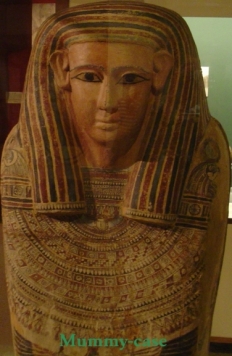
The methods of making mummies evolved over time. Old Kingdom mummies were pickled in Natron solution and wrapped. Greek mummies were submerged in honey (as a preservative and anti-bacterial) and coated with beeswax. New Kingdom mummies had organs removed after the body was coated with Natron and washed. Organs like the eyes, liver, lungs, intestines, and kidneys had their own containers, though usually it was Four Jars in the shape of the Four Sons of Horus. The heart was either left in place or removed and embalmed, replaced with a stone heart Scarab (representing Khepri). The heart Scarab was a source of power for the resurrected Soul. The cavities left behind from organs’ removal were packed with linen and Natron, to dry the interior. The brain was removed by accessing the skull via the bone behind the nose, using a long iron hook. The brain cavity was cleaned with oils or resin by pouring into the nose and rinsing it. (The Egyptians were not that ‘empty headed’). Anything, which may cause decay inside the body, was thus removed and embalmed separately. The brain was discarded, as they did not wish to save it. After all this, the body was coated with Natron, cleaned, and wiped with fragrant oils and incensed. Then it was wrapped with fine or coarse linen, with written prayers inscribed on each layer. Ceremonies occurred while it was wrapped. Jeweled amulets were ritually placed on each layer of wrapping, a collar was placed around its neck, and a realistic mask was placed over its head so that the Soul would recognize it. Flowers and more incense were added on top. Then it was placed into the coffin, resting its head on a headrest, and into the stone Sarcophagus. Tombs contained furniture, offerings, the Sarcophagus, personal items, and gifts from friends and relatives. Pyramids were a form of tomb and later used as initiation temples for priests who performed embalming rites. Eyes were painted on the exterior of coffins so the dead could ‘see outside.’ Funerary texts were written inside coffins, or a papyrus scroll was secured onto the mummy, for their use in entering the Afterlife.
© M7 2009.
Links:
http://www.spurlock.uiuc.edu/explorations/online/mummification/index.html
http://www.ancientegypt.co.uk/mummies/home.html
http://historylink101.net/egypt_1/religion_mummification_process.htm
http://www.touregypt.net/magazine/mummificationinancientegypt.htm
http://www.touregypt.net/featurestories/mummification.htm
http://news.nationalgeographic.com/news/2004/09/0915_040915_petmummies.html
http://www.ancient-egypt-online.com/ancient-egypt-mummies.html
http://www.ancientegypt.co.uk/mummies/home.html
http://historylink101.net/egypt_1/religion_mummification_process.htm
http://www.touregypt.net/magazine/mummificationinancientegypt.htm
http://www.touregypt.net/featurestories/mummification.htm
http://news.nationalgeographic.com/news/2004/09/0915_040915_petmummies.html
http://www.ancient-egypt-online.com/ancient-egypt-mummies.html

M7